Document checklist
Schengen Visa Requirements for Pakistani Applicants
What Pakistani applicants are asked for when applying for a Schengen short-stay visa — the core set every embassy expects, and the extra evidence for employees, business owners, students and sponsored travellers.
Reviewed by Qasim Hussain, Founder, Schengen.pk · Checked against official sources on
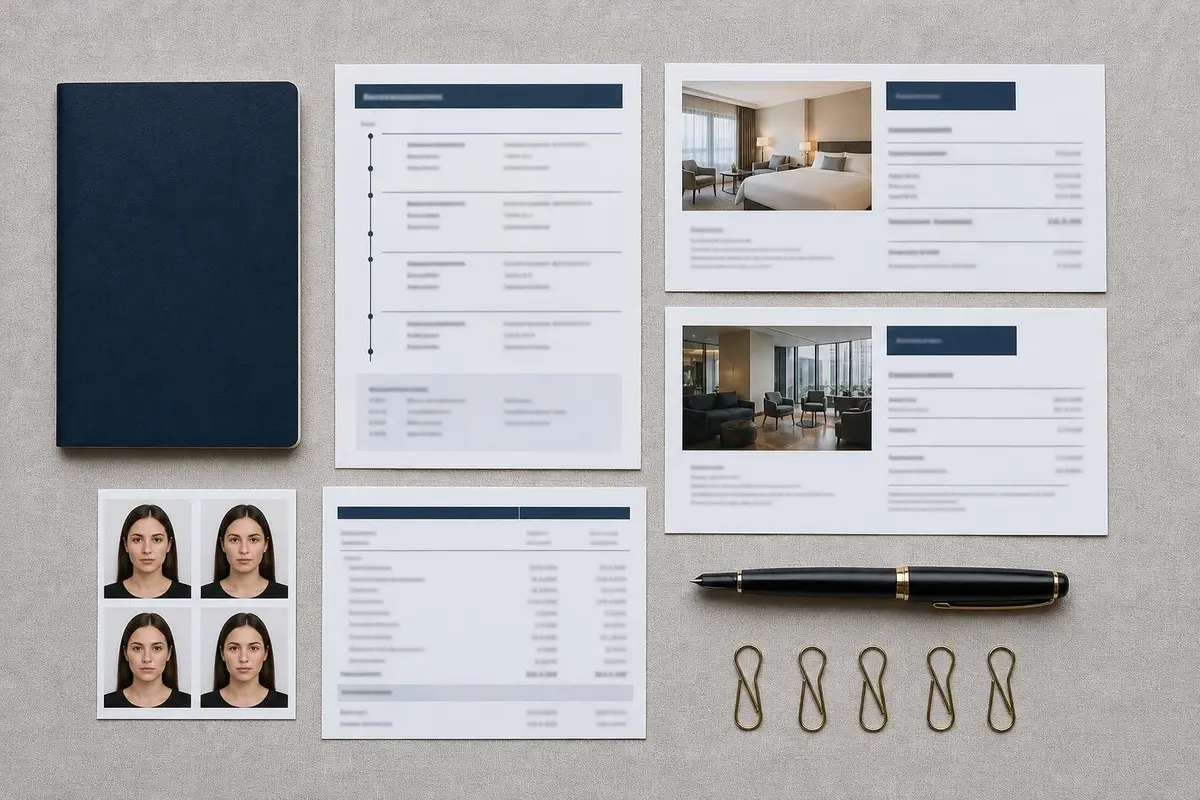
Core documents for every applicant
- Application form for the country you apply to, completed and signed (some countries require their online form, e.g. France-Visas or Germany’s VIDEX).
- Passport issued within the last 10 years, valid at least 3 months after your planned departure from the Schengen area, with at least two blank pages — signed.
- All your previous passports, especially those with visas.
- Recent passport-size photographs meeting the embassy’s specification.
- CNIC copy. Many embassies also ask for a NADRA Family Registration Certificate (FRC) in English.
- Travel medical insurance of at least €30,000, valid in all Schengen states for the whole trip.
- Return flight reservation and accommodation for every night (hotel bookings or an invitation from your host).
- A day-by-day itinerary and a short cover letter explaining the purpose of the trip.
- Bank statements and proof of income (see your profile below).
Additional documents by applicant profile
Salaried employees
- Employment letter (NOC) on letterhead: position, salary, joining date and approved leave dates, stating you will return to work.
- Recent salary slips (Germany asks for the last 3 months).
- Personal bank statements showing salary credits (Germany asks for 6 months).
- Tax records where available, for example your income tax return.
Business owners and self-employed
- Proof the business exists and is active, such as registration with the SECP or a chamber of commerce, or a partnership deed.
- Business and personal tax returns.
- Company and personal bank statements.
- For business trips: an invitation from the company or event in the Schengen country.
Students
- Enrolment letter and NOC from your school, college or university confirming you will resume studies.
- Sponsor’s letter, CNIC, bank statements and income proof.
- Proof of relationship to the sponsor (for example the FRC).
Sponsored travellers and family visits
- Invitation letter from your host, with a copy of their passport or residence permit in the Schengen country.
- If the host covers costs: the official sponsorship or guarantee form the country uses, and the host’s proof of means.
- Proof of relationship — FRC, birth certificate or nikah nama, as relevant.
Minors
- Birth certificate and FRC.
- Consent from both parents (or the parent not travelling), with copies of their CNICs and passports.
- School NOC for school-age children.
Points that matter specifically for Pakistani applicants
- NADRA documents. The FRC is commonly requested to prove family relationships, and the German missions list it for tourist visas.
- Old passports. Embassies in Pakistan often ask for every previous passport, so your travel history can be seen in full.
- Signed passport. The German missions state that an unsigned passport is not valid. Sign yours before your appointment.
- Translations. Documents in Urdu generally need an English translation; check whether your embassy requires a certified one.
- Where you live decides where you apply. Germany and Italy split Pakistan between Islamabad and Karachi by province — see the Germany and Italy guides.
Showing your finances honestly
Officers look for a consistent financial picture: regular income, spending that matches your lifestyle, and enough for this trip without strain. A large deposit shortly before applying, with no explanation, raises questions. If money came from a property sale, a gift or a business, document where it came from.
Some countries publish a daily amount they expect travellers to have. Where your embassy does, we use its figure — we do not quote unofficial ones.
Common mistakes that lead to refusals
- Applying to the wrong country — not your main destination.
- Dates, hotels and the itinerary not matching each other or the form.
- Insurance below €30,000 or not covering the whole stay.
- Unexplained deposits, or statements that do not show the salary on your letter.
- Not declaring earlier refusals.
- Bookings or documents that are not genuine — this can lead to refusal and a ban.
Frequently asked questions
How many months of bank statements do I need for a Schengen visa?
It depends on the embassy. The German missions in Pakistan, for example, ask for 6 months of bank statements and 3 months of salary slips for a tourist visa. Check the checklist of the country you apply to.
What is the minimum travel insurance for a Schengen visa?
At least €30,000 of medical cover, including emergency hospital treatment and repatriation, valid in every Schengen country for your whole trip.
Do I need a confirmed flight ticket?
Usually a reservation (itinerary) is enough; buying a non-refundable ticket before the decision is a risk you do not need to take. Follow your embassy’s checklist if it says otherwise.
Do I have to declare a previous visa refusal?
Yes. Earlier refusals — Schengen or any other country — must be declared honestly. Hiding one is far more damaging than the refusal itself.
Official sources
Requirements, fees and booking routes change. We check this page against the sources below; when anything here differs from what the embassy or its authorised application centre publishes, the official source is correct.
Want your documents checked before you book?
Tell us your destination, travel date, city and profile. We reply with what your case needs and what our help would cost — before you pay anything.